What counts as a hospital-acquired condition
A hospital-acquired condition (HAC) is a problem a patient develops during an inpatient stay that was not present when they were admitted. The Centers for Medicare & Medicaid Services uses this category to decide which complications a hospital should reasonably have prevented, and it links directly to how much the hospital gets paid for that stay. HAC is a payment and policy label, not a clinical diagnosis — it sits above two things people often conflate with it: a healthcare-associated infection (HAI), which is the infection subset of HACs and the category clinicians talk about most, and a patient-safety event, a broader term covering falls, medication errors and other harms whether or not they carry a payment penalty. A single pressure ulcer or catheter infection can be all three at once, described differently depending on whether a nurse, a biller, or a hospital board is talking about it.
Indwelling urinary catheter placed during stay
An indwelling urinary catheter is a thin tube inserted into the bladder to drain urine, usually during or after surgery or for patients who cannot void on their own. Once placed, it gives bacteria a direct route along the outside or inside of the tube into a normally sterile urinary tract.
Here is how one device becomes a counted, penalized condition:
- The catheter is placed during the stay, and clinicians document that the patient did not have a urinary tract infection at admission.
- Bacteria migrate along the device and colonize the bladder.
- A catheter-associated urinary tract infection develops days later, with fever, cloudy urine, or pain as typical signs.
- Because the infection was absent on admission, the present-on-admission indicator marks it as hospital-acquired rather than a condition the patient brought in.
- The case is counted into the hospital's HAC measure rate, one of the metrics reported to CMS.
- Removing catheters as soon as they are no longer needed, plus sterile insertion and daily-necessity checks, is the standard bundle used to bring future rates down.
That present-on-admission indicator is the hinge for every HAC: a condition coded as absent at admission and present at discharge is what makes it "acquired" in the payment sense, regardless of how mild or severe it turns out to be.
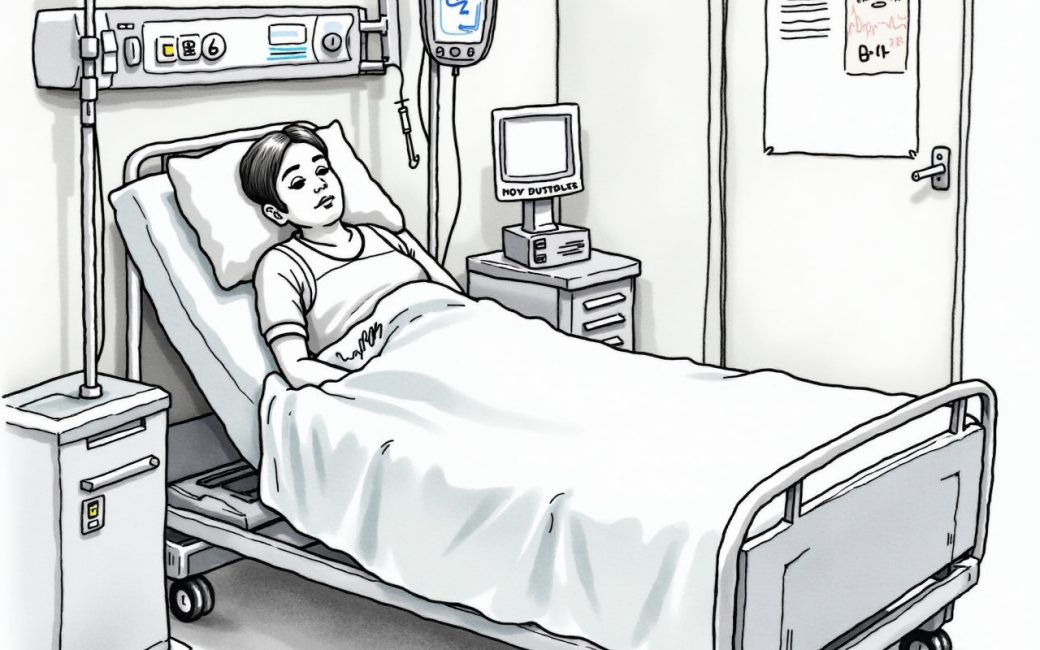
Patient immobile in bed for a prolonged stay
Extended bed rest, common after major surgery, stroke, or in intensive care, puts sustained pressure on skin over bony areas like the heels, hips, and sacrum. That pressure restricts blood flow to the tissue.
Left unrelieved, the tissue breaks down and a pressure ulcer appears — a wound that was not present at admission. Unlike a catheter infection, this is a non-infectious HAC: no organism is involved, only mechanical injury. It is recorded both as a HAC for payment purposes and as a separate patient-safety measure, because pressure injuries are tracked as an indicator of nursing care quality independent of the payment program. Regular repositioning schedules, structured skin assessments on admission and at intervals, and pressure-redistributing mattresses are the main levers hospitals use to bring these numbers down. The category matters because it shows that hospital-acquired conditions are not only infections — a common assumption when the term is used loosely — but include mechanical and pressure-related injuries with entirely different causes and prevention paths.
Surgical site infection
A surgical site infection develops at or near an incision after an operation, ranging from superficial redness to deep infection involving organs or implanted material. It is one of the infection types counted in the HAC measure set that CMS tracks, and prevention centers on sterile technique during surgery, appropriately timed antibiotics, and wound care in the days after.
Central line-associated bloodstream infection
A central line is a catheter placed in a large vein, often in the neck, chest, or groin, to deliver medication or fluids over a longer period. When bacteria enter the bloodstream through that line, the resulting infection is tracked as one of the infection measures feeding into hospital HAC rates, alongside catheter-associated urinary tract infections and surgical site infections.
Patient fall with injury
A fall with injury is a hospital-acquired injury rather than an infection: a patient falls during the stay and sustains harm, from bruising to fracture, that was not present on admission. It sits in the same broad patient-safety category as pressure ulcers — device-related trauma from IV lines, tubing, or restraints falls into a similar bucket — and both are addressed by mobility assessments, bed alarms, and staff rounding rather than by the infection-control bundles used for catheters and central lines.
How one bad outcome becomes a national number
Every counted case feeds into a loop that runs from bedside to federal payment policy. A hospital's HAC measure rates are reported and scored, and hospitals whose rates land them in the worst-performing quartile lose money.
| Step | What happens |
|---|---|
| Measurement | Hospital reports rates across its HAC measures for the performance period |
| Scoring | The hospital is ranked against others; the worst-performing group is identified |
| Penalty | Under the HAC Reduction Program, Medicare inpatient prospective payment system (IPPS) payments to that hospital are reduced |
| Response | Hospitals invest in prevention bundles, staffing, and surveillance to move out of the penalized group |
| Aggregation | National rates across all hospitals are tracked on the AHRQ National Scorecard on Hospital-Acquired Conditions |
A PMC-published analysis of the program's design has examined how well this scoring actually identifies hospitals with genuinely higher complication rates versus hospitals that simply document and report differently — a distinction that matters because the penalty is blunt: it applies to a fixed worst-performing share of hospitals every period, not to a fixed clinical threshold.
Post-hospital syndrome is not the same thing as a hospital-acquired condition
Post-hospital syndrome describes a period of general vulnerability after discharge — reduced physiological reserve, disrupted sleep, poor nutrition, and stress from the hospital stay itself, which raises the risk of readmission for reasons unrelated to the original diagnosis. It is not coded, not present-on-admission-flagged, and not part of any HAC measure. A hospital-acquired condition is a specific, documented complication that occurred and was coded during the stay; post-hospital syndrome is a description of a patient's fragile state afterward. Confusing the two matters because one is billable, trackable, and preventable through specific hospital procedures, and the other is a broader recovery risk that outpatient follow-up, not hospital infection control, is meant to address.
What a patient or family can ask during a stay
Anyone at the bedside can lower the odds of a hospital-acquired condition by asking direct questions rather than waiting for staff to volunteer information.
- Ask daily whether any catheter or central line is still needed, since removal timing is one of the strongest levers against catheter-associated infections and bloodstream infections.
- Ask about a repositioning schedule if the patient cannot move independently, and check visible skin at pressure points for early redness.
- Ask what the fall-risk assessment found and whether a bed alarm or assistance-on-standing plan is in place.
- Ask staff to confirm hand hygiene before any procedure involving a line, wound, or catheter.
Where to check a hospital's own record
Hospital-level HAC performance and pediatric-specific tracking tools are published by bodies including Let's Get Healthy California and children's hospital collaboratives through resources like the Hospital Acquired Conditions Suite. Comparing a specific hospital's rates against the national scorecard before a planned admission is a reasonable step for anyone choosing between facilities, and asking the admitting unit directly about its current catheter and pressure-ulcer rates is a fair question to bring into a pre-admission conversation.