Sudden severe symptoms appear
Yes, urgent care is usually cheaper than the emergency room, but the more useful question to ask first is whether the symptom is life-threatening at all — cost only matters once safety is settled. Chest pain, difficulty breathing, sudden confusion, uncontrolled bleeding, a suspected stroke, or a severely broken bone all point toward the ER, not urgent care.
The decision rule is straightforward:
- Life- or limb-threatening symptoms — call 911 or go straight to the nearest hospital emergency room, since ERs operate 24/7 without an appointment.
- Minor, non-life-threatening problems — a sprained ankle, an ear infection, a minor cut needing stitches — are typically handled at urgent care for less money and less waiting.
Hospitals that publish emergency-department information, including Allegheny Health Network and Inova, frame their ERs around this same split: they exist for conditions that cannot wait, not for symptoms that could reasonably be scheduled the next day.
Patient walks into the ER without an appointment
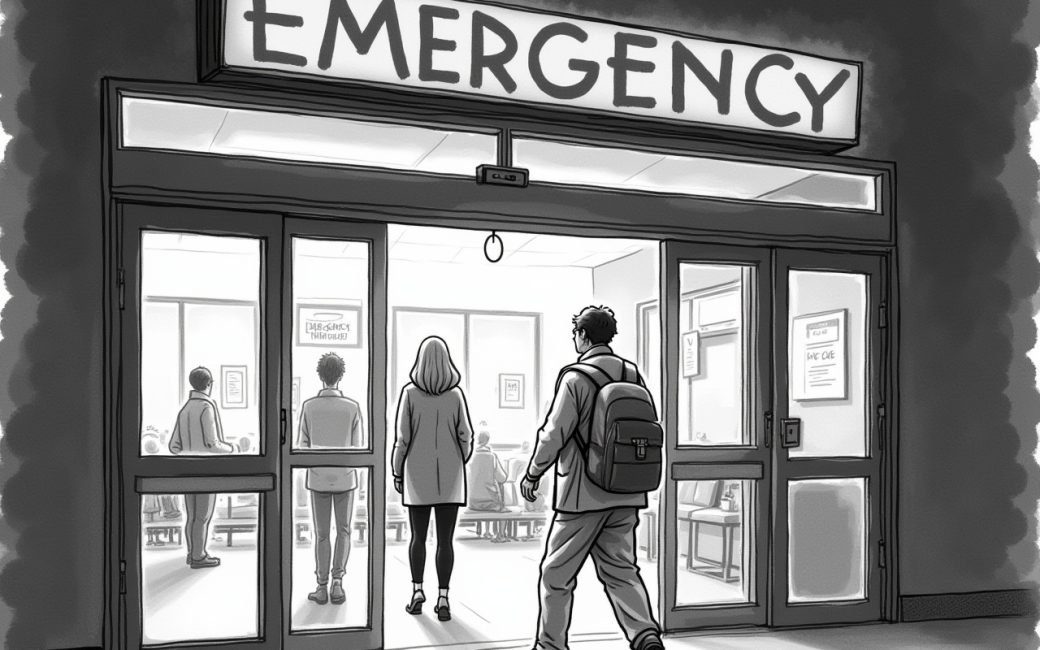
Anyone can walk into a hospital ER without an appointment, and staff cannot turn a patient away for being unable to pay. What happens next is a clinical sorting process called triage: a nurse assesses each arriving patient's symptoms and vital signs and assigns a priority level before anyone is seen by a physician.
Triage means the order of care depends on severity, not arrival time. A patient having a heart attack who arrives after someone with a sprained wrist will be seen first. This is why posted or online ER wait times, of the kind hospitals like El Camino Health and Sherman Oaks Hospital display, are estimates rather than guarantees — a lower-acuity patient can watch that number climb while more urgent cases are moved ahead of them. Registration and insurance verification typically happen alongside or shortly after triage, not before treatment for anything serious.
Need care now and search for the nearest facility
A "nearest emergency hospital" search returns a mix of facility types, and the type matters more than the distance. Three kinds commonly show up:
| Facility type | Open hours | Handles | Typical billing |
|---|---|---|---|
| Hospital emergency department | 24/7 | Full range, including trauma and critical care | Hospital ER charges |
| Freestanding emergency center | Often 24/7, but not hospital-attached | ER-level conditions, limited surgical or ICU capacity | ER-level billing, separate facility |
| Urgent care clinic | Extended daytime hours, not usually overnight | Minor illness and injury | Lower, clinic-style billing |
Before traveling, confirm which type of facility a search result actually is, whether it's currently open, and its exact address — some networks, such as MemorialCare, list several ER locations across a region, and hours can vary by site even under one hospital name. If symptoms are severe or worsening, call 911 rather than self-transporting, since ambulance crews can begin treatment before arrival and radio ahead to the receiving ER.
Emergency department
An emergency department is the hospital-based unit where emergency medicine is practiced — the term is used interchangeably with "emergency room" on most hospital sites. It's staffed and equipped for the full range of acute conditions, from minor lacerations up through trauma, stroke, and cardiac arrest, and it operates around the clock without requiring an appointment, as described on hospital emergency-services pages like Atrium Health's and Inova's.
Urgent care
Urgent care is a walk-in clinic built for problems that need same-day attention but aren't life-threatening — sprains, minor fractures, mild fevers, minor infections, and small cuts. It generally keeps shorter, daytime-and-evening hours rather than running 24/7, and because it isn't equipped for trauma, cardiac events, or stroke, it exists specifically as the lower-cost, lower-acuity counterpart to the ER rather than a substitute for it in a true emergency.
Medical emergency
A medical emergency is a sudden condition that requires immediate ER-level care because delay risks death, disability, or permanent organ damage. Chest pain, stroke symptoms, severe allergic reactions, uncontrolled bleeding, and loss of consciousness all fall into this category. These are the situations where the venue decision made earlier in this piece resolves in one direction only: the nearest ER, reached by ambulance if symptoms are severe enough that self-driving isn't safe.
Emergency room (ER)
The emergency room is the hospital department set up to treat conditions that threaten life or limb, and it's designed to accept anyone who arrives, at any hour, without a prior appointment. This open-door structure is what makes triage necessary in the first place — since patients can't be scheduled in advance, the department has to sort them by clinical urgency the moment they arrive, which is why hospital pages describing emergency room locations consistently emphasize 24/7 availability rather than posted appointment slots.
Freestanding emergency center
A freestanding emergency center provides ER-level emergency care in a building separate from a main hospital campus, but it is not the same thing as urgent care. These centers can typically handle many of the same acute conditions as a hospital ER — chest pain, breathing trouble, injuries requiring imaging — though they may have more limited capacity for surgery, intensive care, or admission compared with a full hospital, and patients needing a higher level of care may be transferred. Billing at a freestanding ER generally follows emergency-department rates rather than urgent-care pricing, which is the detail worth checking before assuming a nearby "emergency" sign means urgent-care costs.
Search "emergency hospital near me" with the facility type in mind — hospital ER, freestanding ER, or urgent care — and confirm current hours before heading out, or call 911 if the symptoms can't safely wait for a drive.